1955 – The Way We Were:
It was in 1955 that campaigner and journalist Tony Lothian, together with war heroine Odette Hallowes and journalist Georgina Coleridge, first assembled leading women from all occupations as Women of the Year at The Savoy, London. Today, as we celebrate the 50th Women of the Year Lunch in the resplendent atmosphere of the Guildhall, London, we reflect back and take a glimpse of life in 1955, a year when we had a Conservative government and two prime ministers, Sir Winston Churchill and Sir Anthony Eden.
The fifties sought to make a strong move away from the conformity of the war years to happier times where leisure activities were on the increase. As industries increased, so did salaries and people started spending. Women followed the glamour of Hollywood films, and stars like Marilyn Monroe and Jayne Mansfield led the way in helping women to lose previous confines. Times were changing, and so were the clothes. World War II had brought mass production of clothing as part of the war effort and, as this expanded, ordinary women had a chance to buy more. Fabrics such as Banlon, Orlon and Terylene, all man-made and crease resistant, were introduced.
Women wore very conservative clothing in the 1950s with a strong emphasis on femininity. Good grooming and a tailored look were ‘de rigueur’, the style completed with stiletto heels and gloves. A lady always wore gloves in the fifties, as she was not seen as properly dressed without them. Dresses or skirts were worn every day and hemlines finished at the knee, or just below it.
Glamour was what women wanted most as they idolised the Hollywood stars who had curves, nipped waists and breast uplifts that almost reached their necks. They struggled into a variety of girdles and roll-ons to help achieve those contours. However, the style most associated with the fifties was the widely swinging poodle skirt, symbolic of the emerging rock and roll era. Plastic poppet beads, waists cinched in by belts and ankle socks became very fashionable and so did floral print swimming caps, their loud colours and big prints becoming the most famous accessory of the decade.
Fifties’ hairstyles were soft and curly and usually worn short. This involved an arduous process of pin curling and rolling, which often involved sleeping in rollers, pins and a hairnet. Straight hair was out; but even with expert curling techniques, a perm was often required as the poodle frenzy gave birth to a new hairstyle, the poodle cut. The best advocate of this style was, of course, the iconic Lucille Ball of I Love Lucy fame.

Left: Terylene Model 1955 | Right: Lucille Ball
After the war, many people expected women to give up their jobs. They felt that the jobs should go to the men returning from war. Consequently, by the mid 1950s, there were fewer women working and fewer jobs remained open to them. In the 1950s, women were encouraged to stay at home and keep house. The home was an important aspect of lifestyle. The average house price was £2,000, the average yearly pay was £600 and the style of the era is often referred to as ‘kitsch’. G Plan furniture was a revolutionary idea for the time and one that set a trend for many years to come.
Plastic, the development of which had begun in the 19th century, was being mass-produced by the 1950s and homes were full of it, from light switches and sockets to the distinctive 300 series Bakelite telephone. Telephones were rented from the GPO (General Post Office) which had a monopoly on all telephone services in the UK, and the average quarterly telephone bill was £2/10-. Rising levels of incomes and an upward economic trend, combined with the growth of easy payments and hire purchase, led to an unprecedented consumer boom. Of the multitude of consumer goods available, the two that changed people’s lives the most were the motorcar and the television.
In the austere climate at the beginning of the decade, cars were a scarce commodity, low cost motoring was important and petrol rationing was common. As a result, the motorbike gained in popularity and the most influential designs of the time were the Vespa and the Lambretta. However, as the years progressed, cars changed everything and by the end of the decade there were over 5m cars on the road in the UK. The major industrialised countries supported their own independent motor industries and Britain was no exception. Its motor industry thrived on the back of cars such as the Austin Healey, the Morris Minor and the popular Wolseley, driven by the British Police Force of the age.
Television became one of the most important changes of the decade. The handful of viewers who watched the BBC’s earliest public television broadcasts in 1936 would have seen little of the diversity to follow. The arrival of commercial television in 1955 ended the BBC monopoly. The ITA service, transmitted from its station at Norwood, was inaugurated on 22 September 1955 when, after a five-minute documentary film, the opening speeches made at a Guildhall dinner by the lord mayor, the postmaster-general and the ITA chairman, Sir Kenneth Clarke, were broadcast.
The rivalry between the two broadcasters had begun and light entertainment became the big draw, with Rediffusion’s Sunday Night at the London Palladium winning huge audiences away from the BBC. Launched by Val Parnell, the first show was presented by Tommy Trinder and regular ingredients of the show were the high-kicking Tiller Girls at the start, the game Beat the Clock in the middle and the famous ending where all the stars of that evening’s show would wave frantically and grin inanely from a central revolving stage.
If commercial television made landmark history in 1955, so too did the BBC both with programming and innovation. Grace Wyndham Goldie, one of the pioneers of current affairs television, relaunched Panorama in this year, with Richard Dimbleby as the main presenter.
Panorama has gone on to become the longest running current affairs programme anywhere in the world. Other programmes first televised by the BBC in 1955 include Dixon of Dock Green, This Is Your Life, The Woodentops and Crackerjack, and on 10 October the BBC began colour television test transmissions on 405 lines from Alexandra Palace.
The popularity of music in the fifties ensured that the gramophone was as important as the radio. For much of the fifties, radio consisted of just three BBC stations, the Light Programme, the Home Service and the Third Programme. The gramophone (the most well-known being the Dansette) was used to listen and dance to the latest hits. Bill Haley & The Comets released Rock Around The Clock and the world rocked as a new era began.
Often referred to as the formative years of the 20th century, the scientific and mass production advances made during the Second World War meant that the fifties changed forever the way that people lived. Founded on principles of peace, positivity and community, the Women of the Year Lunch is as unique and relevant an event today as it was in those early visionary years.
Gill Sinclair
Related posts
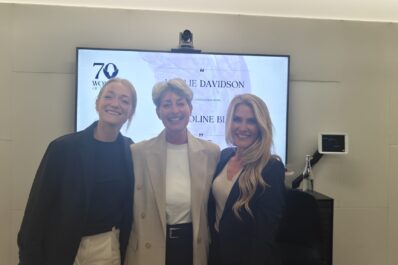
Hollie Davidson in conversation with Caroline Blair
We were thrilled that our speaker for our September event was Hollie Davidson, a Scottish professional rugby union referee contracted to the Scottish Rugby Union, and one of the most ...
Read full article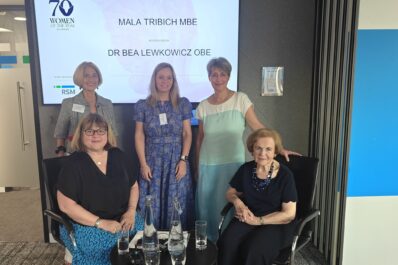
In Conversation Mala Tribich MBE
Having survived the horrors of the Ravensbruck and Bergen Belsen Concentration Camps, Mala came to the UK after World War II and has dedicated much of her life to Holocaust Education. On Holocaust Memorial Day 2026, she was the first holocaust survivor to address the Cabinet in 10 Downing Street. Mala was interviewed by Dr Bea Lewkowicz OBE, a historian, filmmaker, curator, and photographer who was awarded an OBE for services to Holocaust remembrance and education in this year’s New Year Honours List.
Read full article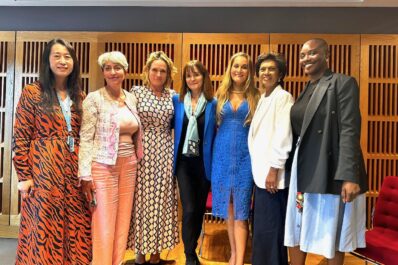
Finding Your Voice – How Women Learn to Speak and be Heard Across a Lifetime
For the last ten years, The Newnham Associates and Women of the Year have held a joint event, to celebrate women and all they achieve and contribute in 21st century Britain.
Read full article